Dutch Van Der Linde's Legacy: How the Legendary Outlaw Could Shape Red Dead Redemption 3's Protagonist
Red Dead Redemption 3 speculation intensifies as Dutch Van Der Linde's legendary charisma and complex legacy fuel thrilling possibilities for the next hero.
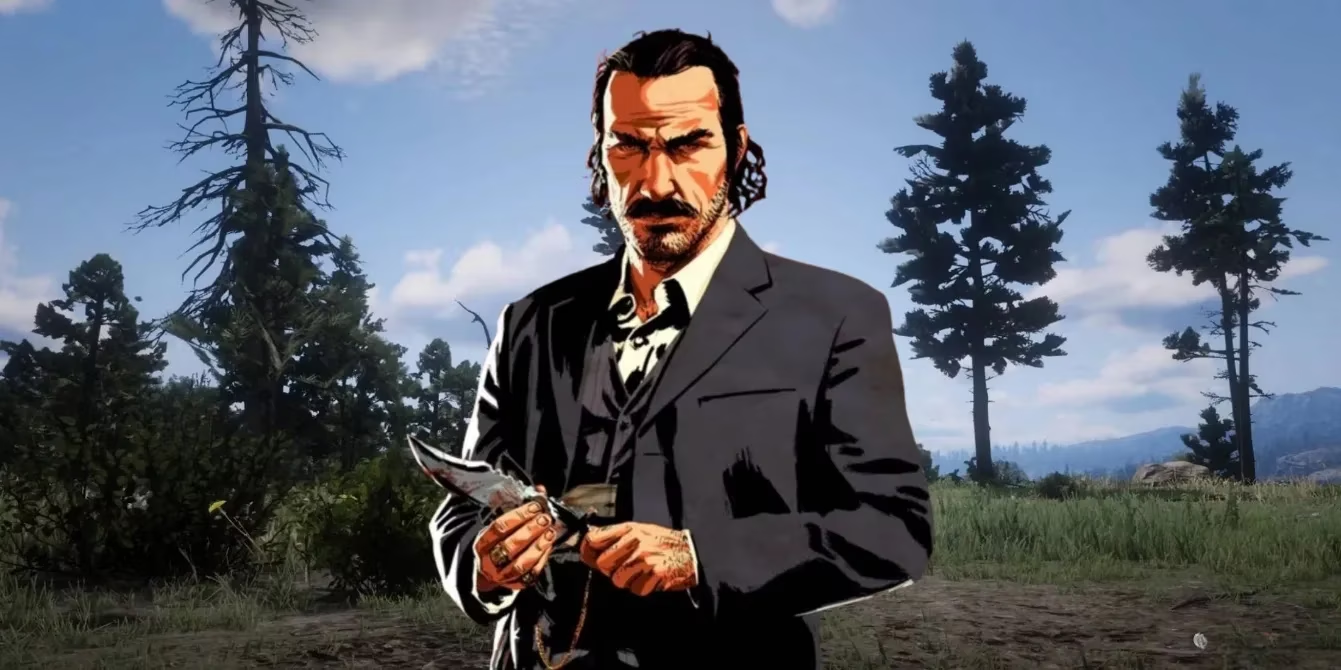
As the gaming world looks toward 2026 and beyond, whispers about Red Dead Redemption 3 grow louder, fueled by speculation and the towering legacy of its predecessors. The landscape of open-world westerns has evolved, but one name continues to cast a long shadow over the franchise's future: Dutch Van Der Linde. The charismatic, tragic leader of the Van Der Linde gang isn't just a character from the past; he's a blueprint, a living, breathing archetype whose very essence could define the next hero of the American frontier. While Rockstar Games remains tight-lipped about any official details, the ghost of Dutch's philosophy—his fierce loyalty, his chaotic brilliance, and his doomed idealism—offers a compelling template for what could come next.
The Unforgettable Charisma of a Leader
Let's be real—Dutch had that something. You know, that magnetic pull that made folks like Arthur Morgan and John Marston follow him to the ends of the earth, even when the writing was on the wall. This wasn't just some two-bit outlaw boss; this was a man who could spin dreams of freedom and a better life with nothing but words. In a potential Red Dead Redemption 3, a protagonist doesn't need to be Dutch, but they could sure use a sprinkle of that magic. Imagine a new character, perhaps operating in the twilight years of the Wild West around the early 1910s, trying to rally a crew when the world is literally moving on without them—trains, telegraphs, and the long arm of the law making the old ways obsolete. That innate ability to inspire, to make people believe in a cause bigger than themselves, is pure narrative gold.
Dutch's brand of loyalty was a double-edged sword, and that's what made it so darn interesting. He was ride-or-die for his inner circle, creating bonds that felt as real as the dirt under your boots. A new protagonist could embody this trait, forcing players into tough moral choices:
-
The Found Family: Building and protecting a makeshift family of outcasts, each with their own quirks and burdens.
-
The Ultimate Betrayal: Navigating the heartbreak when that unwavering loyalty is tested or even shattered from within.
-
The Weight of Command: Feeling the crushing responsibility for every life in the gang, where every decision has a human cost.
Embracing the Beautiful Chaos
If there's one thing you could say about Dutch, it's that the man was... unpredictable. One minute he's quoting philosophers, the next he's orchestrating a train heist that goes sideways in three different ways. This chaotic energy wasn't just a flaw; it was a survival tool in a world of sudden violence. A Red Dead Redemption 3 hero could channel this trait into gameplay and story. Picture this: a character whose plans aren't always neat and tidy, leading to dynamic, emergent missions where things fall apart spectacularly, and the player has to think on their feet. It makes the world feel alive and dangerous, not just a checklist of objectives.
This unpredictability could be mirrored in a game's systems. Maybe the protagonist's relationships with gang members aren't static—they fluctuate based on the chaotic successes and failures of jobs, creating a living, breathing camp dynamic where morale is as important as ammunition.
The Doomed Idealist: A New Hope?
Here's where the real meat of the story could be. Dutch's most defining—and ultimately tragic—trait was his aggressive idealism. He had a plan, and he refused to let go, even as civilization closed in and his own mind began to fray. For a new protagonist, this idealism wouldn't just be a path to tragedy; it could be the core of a player-driven narrative. What if, this time, the player's choices actually mattered in determining whether that idealism is a fatal flaw or a saving grace?
Set in a later period, say the 1910s, the game could explore a protagonist clinging to the myth of the outlaw while the 20th century roars in. Their dream might not be Dutch's anarchic paradise, but perhaps something more personal: saving a family ranch from a railroad company, protecting an entire town from encroaching industrialists, or finding one last place where the old rules still apply.
-
Player Agency in the End: Unlike Dutch's fixed downfall, the new hero's fate could be shaped by key decisions. Will they adapt and find a peaceful resolution, or go down in a blaze of glorious, futile defiance?
-
The Cost of a Dream: The narrative could deeply explore what someone sacrifices—friendships, love, their own sanity—for a principle in a world that no longer has room for it.
A Legacy, Not a Carbon Copy
So, no, Red Dead Redemption 3 doesn't need to be "The Dutch Van Der Linde Origin Story." We've seen his rise and fall. But his shadow is inescapable. The next protagonist can walk a similar path without retreading the same ground. They can have that infectious charisma, that fierce loyalty to a chosen family, that chaotic spark, and that burning idealistic fire. The key difference? The context and, potentially, the outcome.
Rockstar has the tools to build a character who learns from Dutch's legend—a character who might see the futility in blind resistance or who might, against all odds, find a way to secure a better ending for their people. Dutch was a tragic figure because he was a man out of time, broken by the future. The next hero could be someone who navigates that transition, whose story is about change rather than stubborn refusal. They could be the one who finally... lets go.
In the end, Dutch Van Der Linde serves as the perfect narrative cornerstone. He shows what makes a Red Dead protagonist unforgettable: depth, contradiction, and humanity. As we look to the horizon for the next tale from Rockstar, the question isn't "Will the next hero be like Dutch?" It's "How will they carve their own legend, standing on the shoulders of the giant who came before?" The frontier may be closing, but the stories of the people who lived and died on it are forever open for interpretation.