IGN's Face-Off Drama: From Community Fun to Vote Manipulation in the 2026 Game of the Year Race
IGN's Game of the Year So Far Face-Off feature sparked intense online drama, highlighting the challenges of online polls and community engagement.
Over the past week, a significant controversy erupted around IGN's community-driven "Game of the Year So Far" Face-Off feature, transforming what was intended as a fun, informal experiment into a full-blown online drama. The situation involved surprising twists, accusations of foul play, and a massive, unexpected surge in participation that ultimately led to questions about the integrity of online polls. To understand how a simple tool for ranking preferences became a battleground, one must look at the events that unfolded, starting with the tool's inception and culminating in a targeted manipulation attempt that forced IGN to intervene.

Early in 2026, IGN introduced a new version of its Face-Off tool, a pet project designed to let the community create ranked lists for games, movies, shows, and more. The mechanic is straightforward: users are presented with two items and must choose a winner. This could be a classic matchup like The Empire Strikes Back versus Attack of the Clones, or a more contemporary rivalry like different iterations of Call of Duty. Based on these individual choices, the tool generates both a personal ranking and an aggregated community list. While the team acknowledges it's not a perfect system—they hope to refine it for faster, more accurate results—it was launched to foster engagement and spark friendly debates over tough choices.
In late February 2026, after several major game releases, an IGN editor started a specific Face-Off titled "What's Your Game of the Year So Far?" as an informal test. It was crucial to note that this was never presented as an official Game of the Year vote; that traditional event is planned for later in the year. This experiment was more casual, asking for snapshots of current player sentiment. The editor even included items like Elden Ring: Shadow of the Erdtree (a DLC) out of curiosity, bending the typical "full game" rules to see how the community would react. The ranking system itself proved intriguing. It wasn't based on total vote counts but on win/loss ratios. A game added later could theoretically outrank an older one if it won a higher percentage of its matchups, even with fewer total votes. This meant a game's position could fluctuate based on lasting appeal versus fleeting hype.
For months, the Face-Off hummed along with steady traffic. Final Fantasy 7 Rebirth maintained a strong lead, with Shadow of the Erdtree close behind. As major titles like Like a Dragon: Infinite Wealth, Helldivers 2, and Space Marine 2 launched, they climbed into the upper ranks. The editor periodically curated the list, adding well-reviewed or popular games and removing low-performing ones to keep it manageable. Then, everything changed in a flash.

The catalyst was the passionate fanbase of Black Myth: Wukong. Discovering the Face-Off page and seeing their favorite game within reach of the top spot, they mobilized en masse. IGN witnessed a massive influx of traffic from Chinese and other Asian sources. Over a single weekend, Black Myth: Wukong's win percentage skyrocketed from the 60s to an astonishing 90.4%, decisively overtaking Rebirth's 72%. This organic, enthusiastic rally was exactly the kind of community engagement IGN had hoped for—some fans were even livestreaming their page refreshes to watch the climb! The team clarified they did not consider this cheating; championing a favorite game was encouraged. The surge in participation was so immense that the Face-Off garnered nearly twice as many votes in a few days as it had in the preceding six months.
However, the internet's immutable laws soon came into play. With great attention comes the potential for sabotage. Shortly after Black Myth: Wukong's triumphant rise, a bad actor exploited the system. Someone found a way to flood the Face-Off with tens of thousands of votes against the game, causing its win rate to plummet back into the 60s within hours. This targeted attack, seemingly designed to troll the celebrating fanbase, was devastatingly effective. It sparked confusion and anger, with many accusing IGN of tampering with the results—an accusation the company firmly denied.
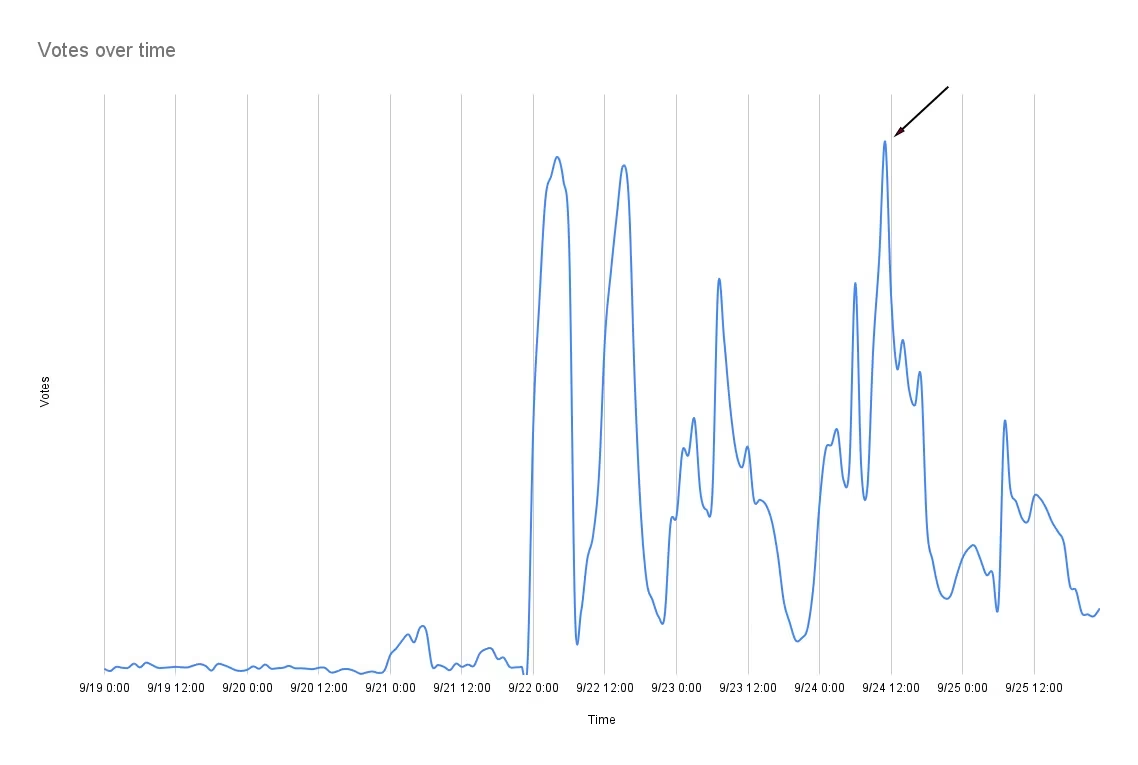
IGN's investigation revealed the stark pattern. Analytics showed the sustained wave of pro-Wukong votes, followed by a sharp, anomalous spike of negative votes. The volume and speed of these losses suggested someone had bypassed the tool's safeguards. The Face-Off uses a randomized, double-elimination bracket system meant to prevent users from voting against the same game repeatedly. The attack indicated this had been circumvented. Faced with this manipulation, IGN had to make a tough call. Because the tool doesn't require an account (to maximize accessibility), distinguishing real votes from fake ones was impossible.
In the interest of fairness, IGN decided to remove all negative votes from the identified fraudulent period—a total of 46,000 losses. This action restored Black Myth: Wukong to the number one position on the list with a 76% win rate. The team acknowledged that some legitimate negative votes might have been caught in the purge, but it was the best corrective action available. They also implemented measures to mitigate the effectiveness of such attacks in the future, though they concede that completely securing an anonymous online poll is a formidable challenge.
The entire episode served as a fascinating, if chaotic, case study in community dynamics. It highlighted both the joyous potential of these tools—uniting fans in shared passion—and their vulnerability. IGN reiterated that Face-Offs are designed for fun, not as scientifically rigorous polls. They learned valuable lessons, particularly about not mixing dynamic community rankings with static promotional content like Playlists, which had caused additional confusion during the event.
As of now, the "Game of the Year So Far" Face-Off continues. New titles like The Legend of Zelda: Echoes of Wisdom have been added, and the community is invited to keep voting and shaping the list. The team hopes other fan communities will join the fray, creating friendly rivalries that make the tool more engaging for everyone. While the drama of September 2026 was unexpected, it underscored the passionate investment gamers have in their favorite titles and the complex reality of managing that passion in an open, online space.