Pocketpair's Pattern of Imitation: Revisiting the Never Grave and Hollow Knight Controversy in 2026
Pocketpair's Never Grave faced Hollow Knight imitation claims, reflecting a studio known for straddling inspiration and controversy.
In the fast-moving world of video games, few indie stories have been as polarizing as that of Pocketpair, the Japanese studio that rocketed to fame with the monster-collecting survival game Palworld back in early 2024. While that title shattered records and became a cultural phenomenon, the developer's reputation for drawing heavily on familiar aesthetics turned every new announcement into a lightning rod. Two years later, in 2026, the gaming community still discusses the precarious line between inspiration and imitation, and few examples capture that tension better than Pocketpair's 2024 Metroidvania, Never Grave: The Witch and The Curse. The game served as a case study in how a small studio's visual callbacks to a beloved indie classic could spark instant backlash—and how that turmoil often says as much about player protectionism as it does about design ethics.
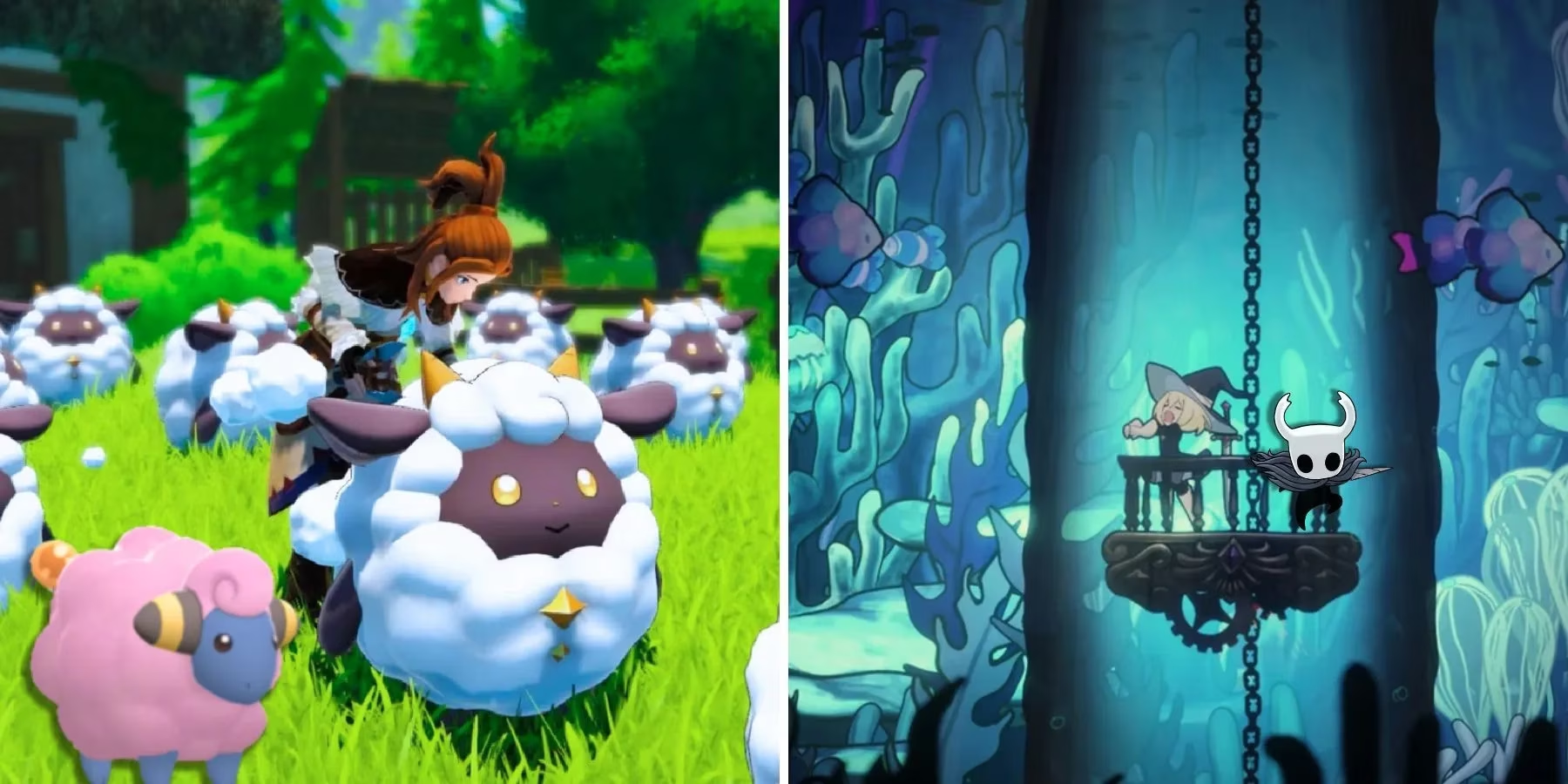
Pocketpair was no stranger to controversy by the time Never Grave entered early access in the first quarter of 2024. The studio's earlier title, Craftopia, had already weathered accusations of imitating The Legend of Zelda: Breath of the Wild's open-world blueprint. Then came Palworld, a game that CEO Takura Mizobe openly credited to inspirations like Ark: Survival Evolved and Rust, yet which the internet relentlessly compared to Pokémon. Despite—or perhaps because of—the heated debate over its creature designs, Palworld soared past two million concurrent Steam players and sold over seven million copies in its first five days. This explosive success meant that every subsequent Pocketpair project would be scrutinized through a lens of heightened sensitivity, and Never Grave walked right into that crossfire.
Never Grave was pitched as a hand-drawn roguelite Metroidvania where a cursed hat assists the player through a crumbling fantasy world filled with puzzles, platforming challenges, and village-rebuilding mechanics. On paper, the premise was fresh enough to stand on its own. However, the debut trailer immediately set off alarm bells for fans of Team Cherry's 2017 masterpiece, Hollow Knight. The footage showcased a protagonist executing a double-jump and a directional dash that mirrored the Knight's signature moves with eerie precision. Environments such as mossy caverns, ancient ruins, and fungal groves seemed lifted straight from Hallownest, while certain enemy types—floating spellcasters with telegraphed attack patterns, lumbering shelled creatures—bore an uncanny resemblance to Hollow Knight's bestiary. Even the UI elements, from the soul-like energy meter to the map system, felt like a thin reskin of the established template.
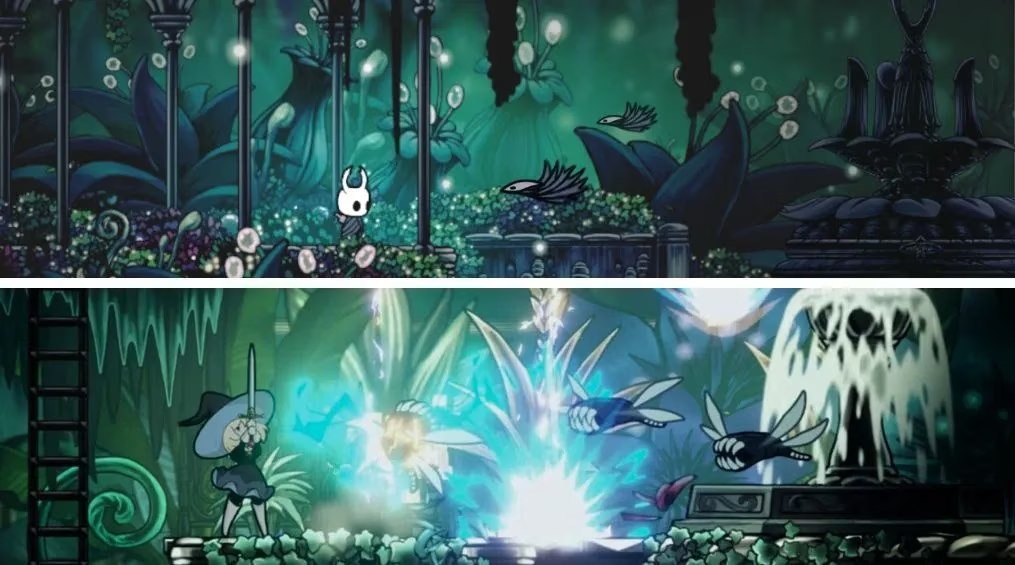
The immediate reaction was a wave of criticism across forums and social media. Many argued that while borrowing gameplay concepts is normal in the industry, Never Grave had crossed into aesthetic cloning. The visual parallels were so strong that some players labeled it a "Hollow Knight reskin" rather than a title offering its own identity. This was not simply a case of two games sharing a genre; the specific execution of traversal mechanics, the atmospheric lighting, and even the animation timings felt painstakingly replicated. In 2026, modding communities have successfully demonstrated how easily Never Grave sprites could be swapped with Hollow Knight counterparts with minimal animation retooling, a fact that continues to fuel retrospective analysis about the game's development process.
What made the controversy particularly biting was the David-versus-David nature of the perceived offense. When Palworld was accused of mimicking Pokémon, many defenders pointed to Nintendo's corporate might and argued that a cheeky indie homage did little harm to a multi-billion-dollar franchise. But Hollow Knight was itself the product of a tiny team, Team Cherry, which spent years painstakingly crafting its hand-drawn world. Ripping pages from that book felt less like punching up and more like undermining a peer. This distinction resonated deeply with indie game communities in 2024 and still influences how homage is policed in 2026. The sentiment was that borrowing from a fellow struggling artist breaches an unspoken ethical code, whereas sampling from a titan might be considered a rebellious act.
Pocketpair never explicitly acknowledged Hollow Knight as an influence, just as they had avoided naming Pokémon as a direct model for Palworld. In interviews, Mizobe and his team focused on the game's unique selling points: the sentient hat that possesses objects, the base-building meta-game, and the procedurally generated dungeons that distinguished it from a purely handcrafted campaign. Those features did carve out a niche—Never Grave ultimately sold well enough to receive consistent post-launch updates through 2025, including a multiplayer expansion that leaned heavily into its roguelite loop. But the shadow of the controversy never fully dissipated. User reviews to this day are split between those who praise the satisfying progression and those who cannot overlook what they see as a derivative core.
Looking back from 2026, the Never Grave episode illuminates a critical evolution in how players evaluate indie games. Steam's recommendation algorithms and social media trend cycles have made visual distinctiveness a premium commodity. A game that looks like a beloved classic can generate immediate attention, but it also triggers a defense mechanism from fan communities who feel protective of the original's legacy. For every success story like Palworld, which thrived despite—or because of—its familiar visual language, there is a cautionary tale like Never Grave that never quite escaped the comparison. The game's concurrent player counts, while healthy, never approached the explosive numbers of Palworld, and some analysts attribute that ceiling to the credibility gap created by the Hollow Knight parallels.
Yet, in an ironic twist, the controversy may have also introduced many players to the Metroidvania genre who then went on to discover Hollow Knight and its impending sequel, Hollow Knight: Silksong, which remains one of the most anticipated titles of the 2026 release calendar. The attention, even if negative, reinforced the iconic status of Team Cherry's creation. In this sense, the Never Grave debate became a cultural touchpoint that solidified the community's standards for artistic integrity while highlighting the fine line between being inspired by a masterpiece and simply mirroring it.
As the industry moves forward, developers like Pocketpair continue to iterate, and Palworld has since expanded into a full live-service ecosystem with countless updates. The studio's newer projects seem to have adopted a more cautious approach to visual referencing, reportedly hiring additional art directors to nurture original styles. The story of Never Grave serves as a permanent reminder that in the age of viral trailers and instant global scrutiny, a game's first impression is often defined not just by what it offers, but by what players recognize—whether the developer intended it or not.