Ray Tracing in 2026: The Quiet Revolution That Reshaped How I See Games
Ray tracing in Alan Wake 2 transforms lighting from gimmick to cinematic art, delivering emotionally resonant visuals.
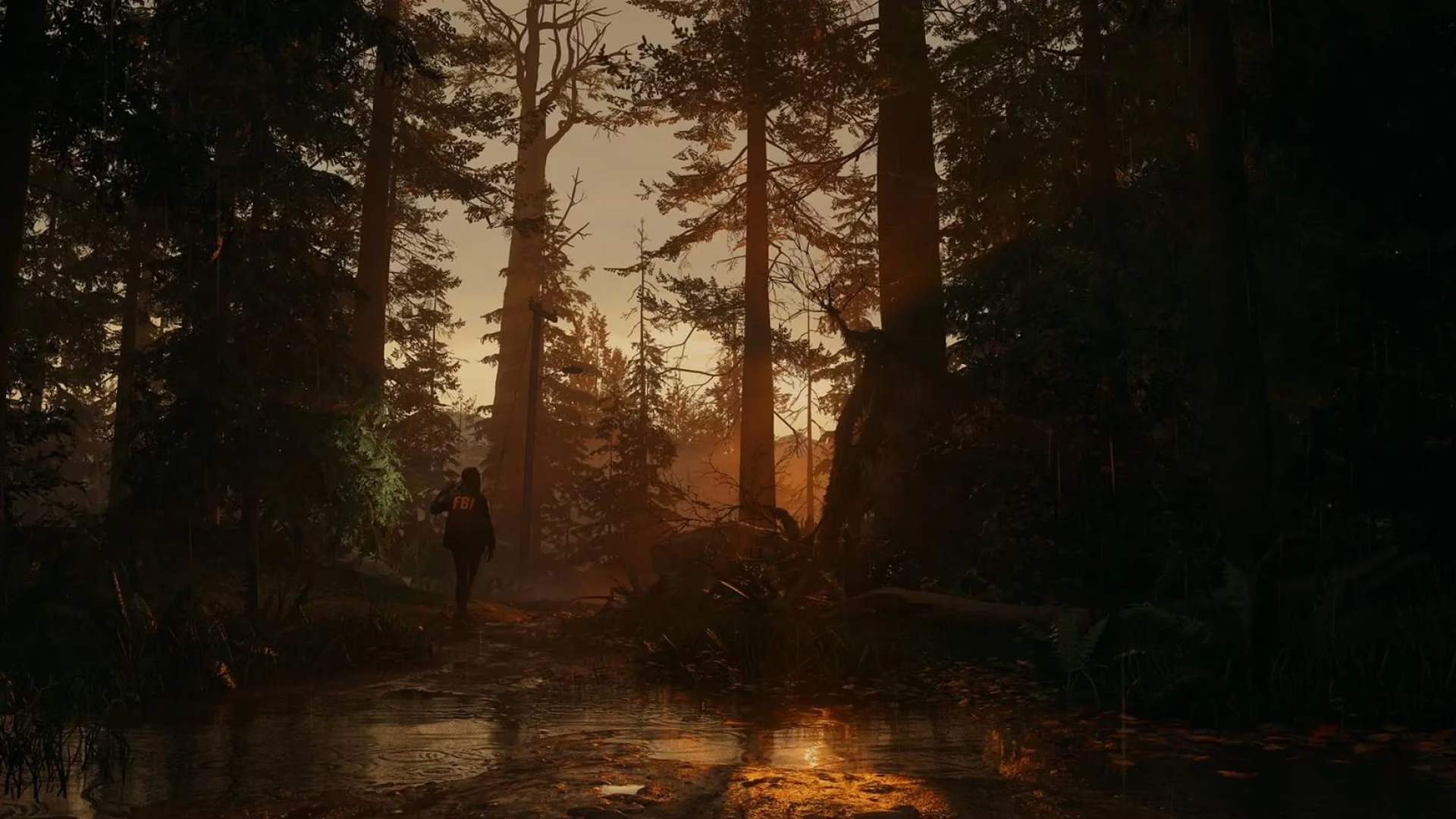
I still remember the first time I flicked the ray tracing switch in a game back in 2021. My RTX 2060 wheezed like an asthmatic vacuum cleaner, frame rates plummeted, and I was left staring at a slightly shinier floor, wondering what all the fuss was about. Roll forward to 2026, and I'm sitting here replaying Alan Wake 2 with path tracing enabled, convinced that real-time lighting has finally become the painter's brush I always dreamed it would be—not just a gimmick for wet pavement and glossy puddles.
The transformation has been more profound than I expected. For years, the narrative around ray tracing was that it made things "prettier," but it never felt essential. It was the tech equivalent of sprinkling edible gold flakes on a cupcake: visually striking but ultimately superficial. What changed for me was realizing that ray tracing isn't about shiny objects—it's about how light behaves when you're not looking directly at it. It's the subtle bounce of a sunset through a window, casting a warm orange smear on a dusty bookshelf, or the way a neon sign bleeds into the fog in a rainy alley. Those moments aren't just "realistic"; they're emotionally resonant in a way rasterized lighting could never fake.
Let me give you an odd but fitting analogy. Rasterization is like a marionette show: every shadow and highlight is pre-calculated, carefully puppeted into place to sell the illusion. Ray tracing, on the other hand, is like releasing a thousand fireflies into a room at dusk and letting their organic glow reveal the space naturally. The first time I saw Alan Wake 2 running on a 2025-era GPU with full ray reconstruction, I felt like I'd been watching fireflies all along but had only just started to see the contours of the room.
Of course, the tech hasn't overcome every hurdle. Even in 2026, enabling full path tracing on a title like Cyberpunk 2077's Phantom Liberty still requires the kind of GPU that costs as much as a used hatchback. But the performance gap has narrowed into something far more manageable. Thanks to dedicated AI denoisers and frame generation that have matured significantly since the DLSS 3.5 days, I can now get a locked 60 FPS at ultrawide 1440p with high ray tracing settings on a mid-range RTX 5070. The efficiency gains are staggering. It reminds me of when smartphones first got GPS: initially it drained your battery in an hour, but now it's a seamless background service you take for granted.
What excites me most is how developers have started baking ray tracing into their creative process, not just as a post-launch patch. Remedy's Northlight engine in Alan Wake 2 treats path tracing as a baseline lighting model, which then scales down for console performance modes. This top-down approach means even without a monster PC, the art direction benefits from a unified lighting philosophy. Surfaces are glossier, sure, but it's the weird, incidental reflections that get me: an external shop window refracted backward into a framed picture of a mountain lake, creating a surreal meta-reflection you'd never script manually. It's the visual equivalent of overhearing a conversation you weren't meant to hear—a tiny, unplanned detail that makes the world feel alive.
Another metaphor that stuck with me is that traditional game lighting is like cooking with a recipe book that only has 12 herbs. You can make delicious food, but you'll eventually taste the repetition. Ray-traced global illumination is like foraging in a meadow: you discover flavors (light interactions) you didn't even know existed, and they vary with every minute change in the environment. In Alan Wake 2's dense forests, the light filtering through canopy gaps creates dappled shadows that shift authentically as clouds move overhead. It's no longer a static stencil; it's a living, breathing thing.
Looking ahead to the rest of 2026, I'm cautiously optimistic. We're seeing more games ship with hardware-accelerated ray tracing as a core requirement, not an optional extra. Consoles have caught up too: the PS5 Pro and the next-gen Xbox refresh now handle decent path tracing at 30 FPS, which, while not ideal for competitive play, delivers cinematic single-player experiences that rival pre-rendered cutscenes from five years ago. The real game-changer, however, might be neural rendering models that predict light transport with minimal compute cost—imagine a lightweight AI that learns how a specific scene's bounces behave and fills in the blanks like an artist's assistant. It's not pure physics simulation, but it feels like the pragmatic bridge toward truly photorealistic real-time graphics.
Still, I won't pretend ray tracing is a magic wand. Indie games with stylized visuals often look better with clever baked lighting, and I'd rather see a well-lit cel-shaded world than a mediocre ray-traced one. But for immersive sims, horror games, and anything that relies on atmosphere, ray tracing has become my secret ingredient. Playing Alan Wake 2 at night with headphones and a path-traced flashlight cutting through volumetric fog is a masterclass in tension. The light doesn't just illuminate; it feels like a character in itself, probing the darkness and revealing details slowly, as if the environment is reluctant to give up its secrets. That's the promise I bought into years ago, and it's finally being honored—not with more shine, but with deeper shadows, stranger reflections, and a quiet respect for how light actually behaves when no one is scripting it.