Roger Clark Reveals His Personal Canon Ending for Red Dead Redemption 2's Arthur Morgan
Red Dead Redemption 2's canon ending, as revealed by Roger Clark, powerfully celebrates Arthur Morgan's high-honor path and ultimate redemption.
In the vast, unforgiving world of Red Dead Redemption 2, Arthur Morgan's final ride is a moment etched into gaming history. While the destination is tragically fixed, the journey there is shaped by the player's choices, a testament to the game's narrative depth. For Roger Clark, the actor whose soulful performance breathed life into the iconic outlaw, the question of Arthur's true ending isn't just academic—it's personal. In a recent 2026 interview, Clark shared his definitive take on Arthur Morgan's final chapter, offering fans a poignant glimpse into the heart of the character he helped create.
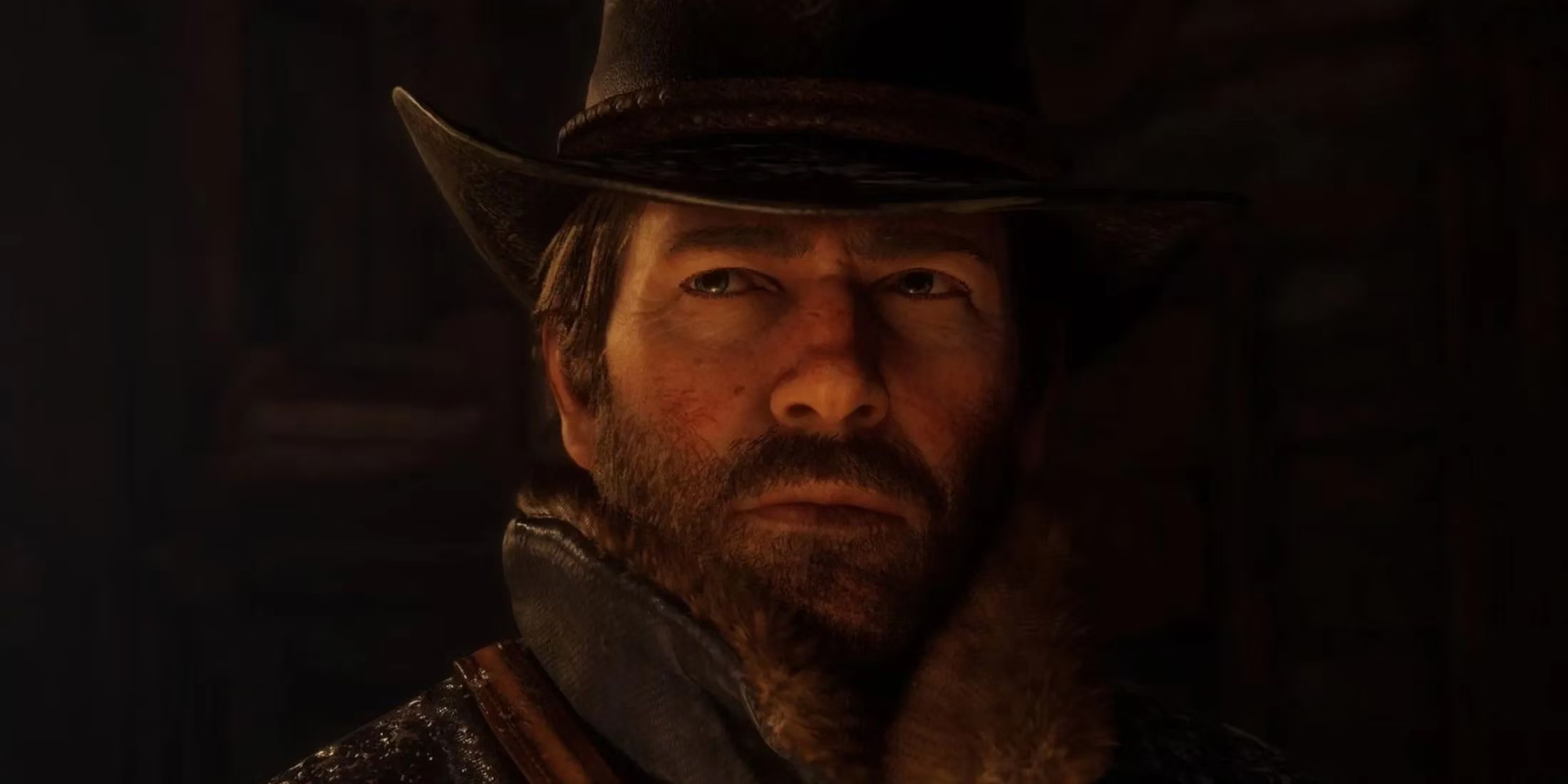
When asked point-blank what he considers the canon ending for Arthur, Clark's answer was as clear as the skies over Big Valley. For him, the high-honor path where a dying Arthur helps John Marston escape is the only ending that truly fits. "Arthur's days are numbered," Clark reflected, his voice carrying the weight of someone who lived in Arthur's boots for years. "What's money gonna do him anyway? You might as well help John." This perspective cuts to the core of Arthur's redemption arc, transforming his final acts from desperation into a legacy of sacrifice. It's the ultimate cowboy's code, where loyalty and honor outweigh a chest full of gold, especially when you're staring down the barrel of a then-incurable disease like tuberculosis.
The beauty—and tragedy—of Red Dead Redemption 2 lies in its player agency. Rockstar crafted a narrative where you can steer Arthur toward nobility or let him embrace his darker impulses. Let's break down the key differences in the endings:
| Aspect | High Honor (Help John) | Low Honor (Go for Money) |
|---|---|---|
| Final Mission | Aiding John's escape from the Pinkertons. | Returning to the cave for the Blackwater money. |
| Arthur's Motivation | Selflessness, legacy, and redemption. | Greed, desperation, and self-preservation. |
| Final Antagonist | A dramatic showdown with Micah Bell. | A bleak, often quicker demise. |
| Thematic Weight | A bittersweet, heroic sacrifice. | A tragic, nihilistic end. |
Clark's endorsement of the high-honor path isn't just an actor's preference; it feels like an insight from the character's own soul. Having brought Arthur to life through both voice and motion capture, Clark understands the man's core better than almost anyone outside the writer's room. He argued that by the game's final chapters, a weary Arthur has seen too much—the gang fracturing, Dutch's descent into madness, his own failing health. In that context, helping John and his family become "the one good thing" in a life of chaos isn't just a choice; it's Arthur making his last stand for something that matters. It's him going out not with a whimper, but by defining what he stands for.
Of course, the game doesn't force this path. You can absolutely play Arthur as a stone-cold outlaw right to the bitter end. The low-honor route offers its own brutal, tragic poetry. But for Clark, and for a massive portion of the game's passionate community, the redemption in Red Dead Redemption 2 isn't just in the title—it's in Arthur's final, selfless act. This flexibility is a huge part of the game's legendary replayability. You can experience the epic campaign multiple times, making different choices at key moments like:
-
Interacting with strangers on the road (help or rob them?).
-
Dealing with camp members and their requests.
-
The infamous Thomas Downes debt collection mission, the pivotal moment of infection.
Without an official word from Rockstar Games—which, as of 2026, has not released a sequel or DLC that definitively locks in one ending—Clark's opinion is the next best thing to gospel. He's not just the voice and face; he's become a beloved ambassador to the community, known for his award-winning performance and his genuine, ongoing interactions with fans. His take resonates because it feels earned, a conclusion drawn from living the role rather than just reading a script.
So, what's the takeaway for players in 2026, whether they're saddling up for the first time or returning for another ride? Roger Clark's canon ending presents Arthur Morgan's story as a powerful parable about legacy. In a world that's changing faster than a stagecoach robbery, Arthur chooses to help build a future he won't live to see. It's a reminder that our choices, especially our final ones, define us more than our circumstances ever could. For Arthur Morgan, the real treasure wasn't in a cave; it was in giving John Marston a fighting chance, a final act of grace that ensured the outlaw's legend would be about more than just guns and gold. That, according to the man who knew him best, is how Arthur Morgan truly found his redemption.
Community playthrough patterns can be cross-checked via HowLongToBeat, where completion-time data and user-submitted play styles help contextualize why many players still gravitate toward Red Dead Redemption 2’s high-honor finale—an ending whose slower, more deliberate pacing often aligns with exploration-heavy runs that emphasize Arthur’s redemption and the emotional weight of helping John escape.