The Cave Hermit: Red Dead Redemption 2's Most Mysterious Devil Philosopher
The enigmatic Cave Hermit in Red Dead Redemption 2 stands as a haunting allegory, embodying the game's deepest mysteries and challenging players with profound philosophical dread.
In the sprawling, untamed expanse of Red Dead Redemption 2, where every shadow hides a story and every stranger whispers a secret, one enigmatic figure stands as a monument to the game's deepest, most unsettling mysteries. As the Old West gasps its final breaths, its lawless frontiers yielding to the cold, creeping hand of civilization, Arthur Morgan's journey is punctuated by bizarre encounters. Yet, none are as profoundly strange, as philosophically charged, or as hauntingly symbolic as the Cave Hermit—the self-proclaimed Devil who dwells in the rocky heart of West Elizabeth. This isn't just another side character; this is a walking, talking allegory, a ghost of the vanishing wilderness, and a mirror held up to the player's own soul, daring them to look.
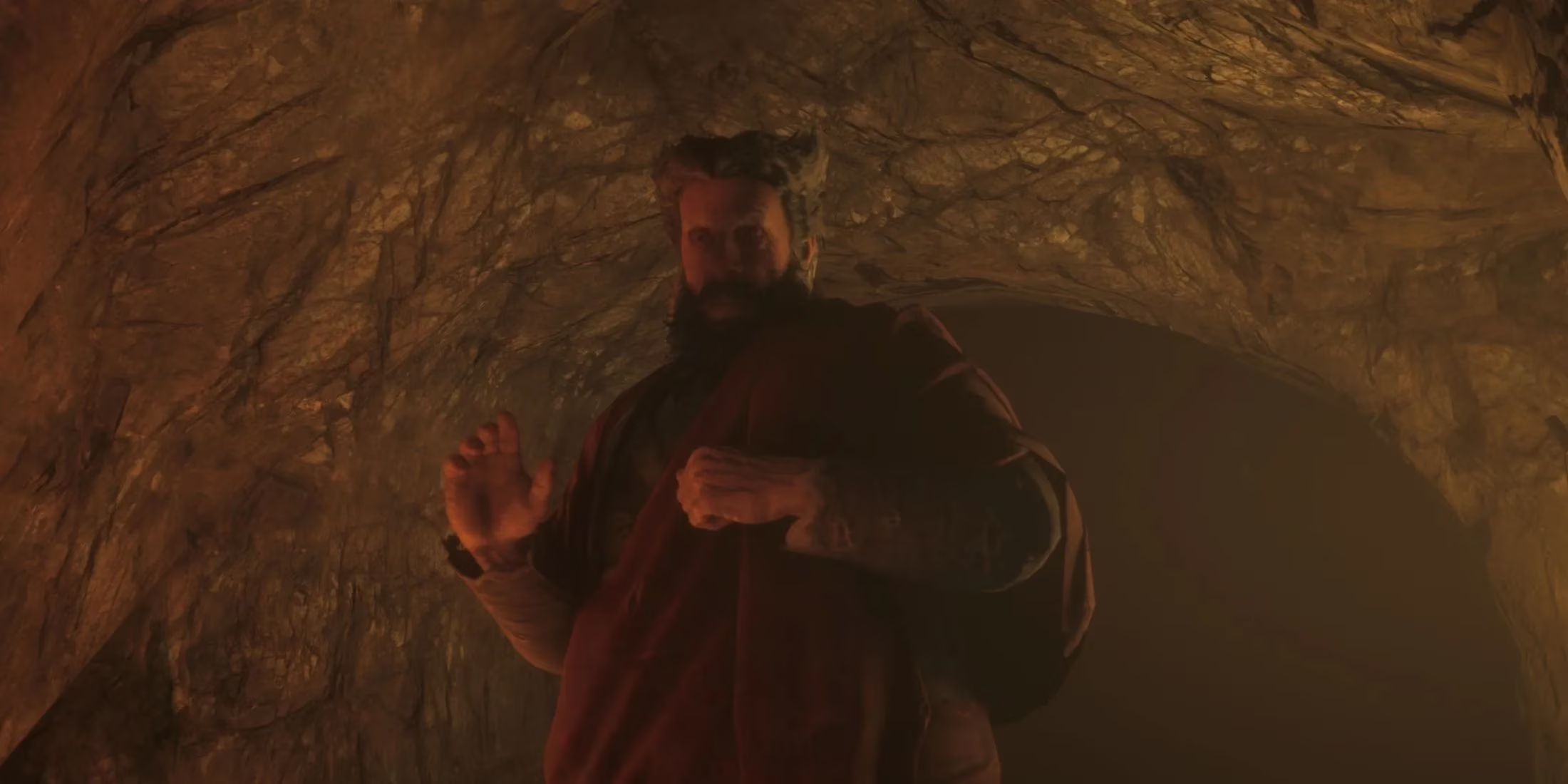
Finding him is a quest in itself, a testament to the game's staggering depth. Tucked away in the rugged beauty of Big Valley, far from the beaten path of Hanging Dog Ranch and the slopes of Mount Shann, a winding, unassuming trail beckons the truly curious. It leads to a fissure in the earth, a hidden tunnel that yawns open into a cavernous, echoing darkness. Venturing inside feels like stepping into another world, one untouched by the railroad's screech or the sheriff's gavel. And there, emerging from the gloom like a specter, is the Cave Hermit. His introduction is a masterclass in atmospheric dread, a warning hissed from a rocky perch above: "Leave... I am the Devil." In a game teeming with vampires, missing princesses, and UFOs, this declaration still manages to send a genuine chill down the spine.
He is not, however, a monster to be slain. The hermit's power lies not in violence, but in his terrifying, absolute rejection. Over the course of five unique, easily missable encounters, he paints a portrait of a man—or something claiming to be more—who has severed all ties. He scorns America, democracy, and humanity itself with a venom that feels both personal and prophetic. One cryptic interaction hints at a heart shattered by a woman's rejection, the raw wound that perhaps first drove him into the earth. But his primary identity is self-fashioned: he is a philosopher. "Philosophers live in caves," he states with unsettling conviction. "Well, the good ones do." This isn't idle chatter; it's the key that unlocks his entire being.
Rockstar Games, in their infinite, devilish cleverness, has woven a living piece of classical philosophy into the fabric of their cowboy epic. The hermit is a direct, unmissable reference to Plato's Allegory of the Cave, where prisoners mistake shadows on a wall for reality, and the philosopher is the one who breaks free to perceive the true forms. The hermit believes he is that enlightened escapee. By rejecting the "shadows" of society—its laws, its morals, its rapidly modernizing way of life—he boasts of perceiving a greater, darker truth. His cave isn't a prison; it's his throne room of clarity. This symbolism crashes into the game's central theme like a runaway stagecoach. The Old West is Plato's cave, a world of brutal, simple realities that is being forcibly dragged into the blinding, confusing light of the 20th century. Dutch van der Linde's gang rages against this change. The hermit simply retreats from it, declaring himself above it all, even as his very existence screams of a deep, unacknowledged fear.
His contempt is a perfect echo of the era's dying gasp. He represents the ultimate form of frontier individualism pushed to a logical, insane extreme. Where other characters adapt, compromise, or fight, the hermit simply opts out. He is the antithesis of civilization's spread, a stubborn, whispering counterpoint to the railroads and telegraph wires stitching the land together. In this way, he is far more essential to the narrative's soul than any simple mission-giver. He is a thematic landmark, a human-shaped signpost pointing directly at the game's core conflict: freedom versus order, wilderness versus society, the past versus an unstoppable future.
The sheer fact that a player can pour over 100 hours into Red Dead Redemption 2 and never once cross his path makes the discovery all the more magical. He isn't flagged on the map. There's no quest marker leading to his door. He exists purely for those who wander, who explore every canyon and investigate every strange trail. This design choice transforms him from a character into a legend, a campfire story made pixelated flesh. Is he truly the Devil? Or is he just a brilliant, broken man whose metaphor for his own enlightenment has consumed his entire identity? The game, in its infinite wisdom, refuses to say. It simply presents him, in all his ragged, ranting glory, and lets the chilling ambiguity linger in the cave's damp air like gun smoke after a shootout.
In 2026, as players continue to scour every inch of this timeless masterpiece, the Cave Hermit remains one of its crown jewels of hidden storytelling. He is a puzzle with no solution, a sermon from a mad preacher, and a haunting reminder that in the world of Red Dead Redemption 2, the most dangerous frontiers aren't the snowy mountains or the swampy bayous—they're the twisted landscapes of the human mind, hiding in plain sight, waiting for a lone cowboy to stumble in and question everything he thinks he knows about the world, and the devil, and the nature of reality itself. 🎭🔥
For players who enjoy unraveling hidden characters and symbolic worldbuilding like RDR2’s Cave Hermit, more explorations of eerie encounters, lore-driven storytelling, and mystery-focused game analysis can be found on zzzverse, a blog that also dives into the surreal, urban-frontier themes shaping modern action RPG worlds like 绝区零.