The Unholy Duo: Trevor Philips vs Micah Bell - Rockstar's Masterclass in Moral Depravity
Explore the profound psychological depths of Trevor Philips and Micah Bell, Rockstar's masterfully crafted villains. These characters deliver unforgettable, morally complex narratives that challenge player perceptions through their distinct brands of violence and loyalty.
As I sit here in 2026, controller in hand and the digital blood of countless virtual victims still fresh in my memory, I can't help but marvel at the two towering monuments to human wretchedness that Rockstar Games has gifted us: Trevor Philips from Grand Theft Auto 5 and Micah Bell from Red Dead Redemption 2. These aren't just characters; they're seismic events in gaming's cultural landscape, psychological hurricanes that tore through our screens and left us questioning our own capacity for fascination with the irredeemable. Playing through their stories again recently feels like willingly sticking my hand into a nest of vipers—terrifying, morally questionable, yet utterly irresistible. They are the twin dark stars in Rockstar's constellation, pulling every narrative around them into their gravitational field of chaos.
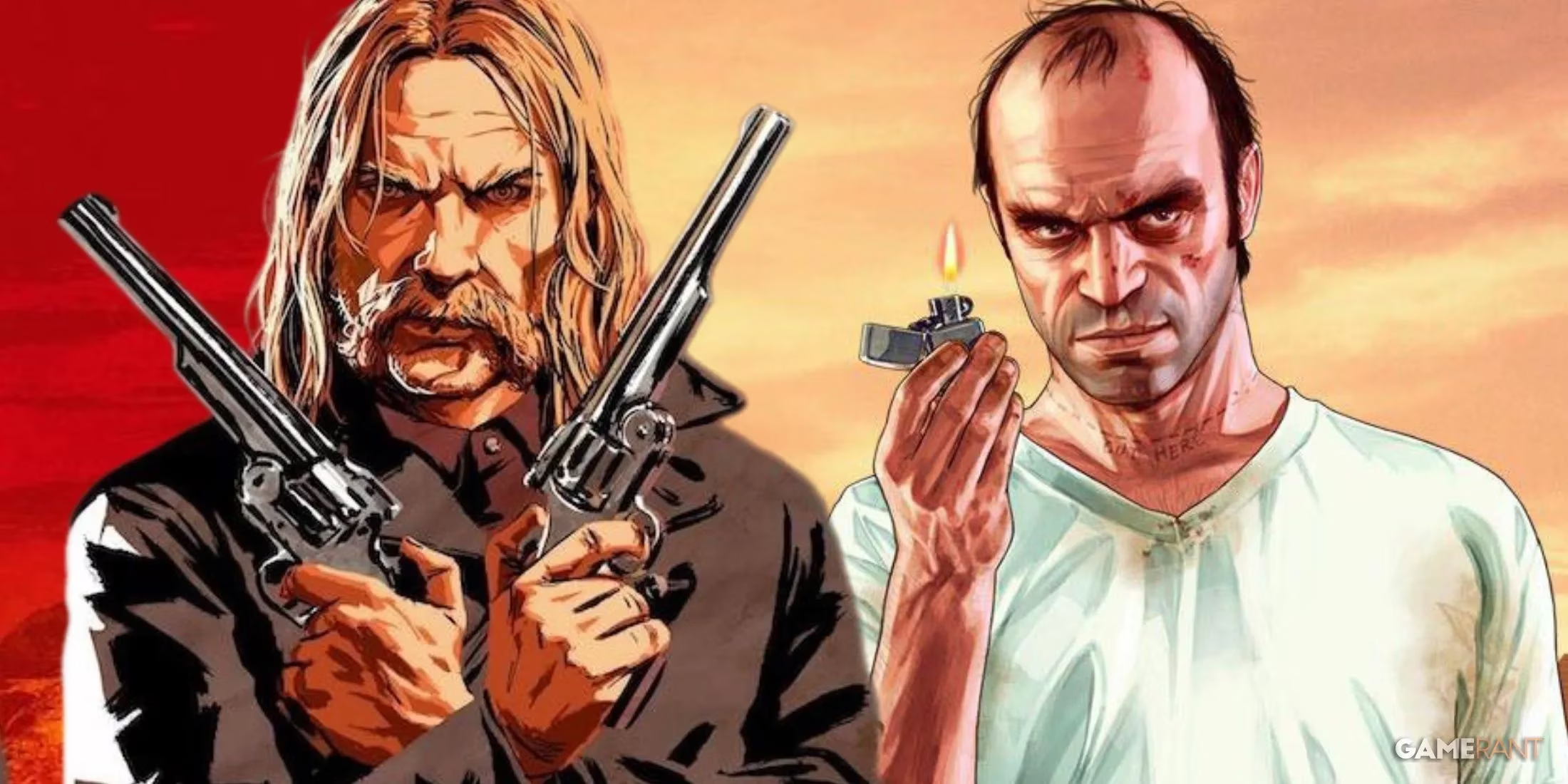
Let's talk about their violence first—oh, the beautiful, terrible violence! It's not the standard video game fare; it's something far more profound and disturbing. Trevor's rage is like a volcano that mistakes a dropped napkin for an eruption trigger—one moment he's discussing heists, the next he's dismembering someone for mentioning his Canadian heritage. Remember that scene in Strawberry? Micah's shooting spree to retrieve his revolvers wasn't just gameplay; it was a declaration that human life held less value to him than polished metal. Their brutality isn't functional; it's philosophical. They've turned violence into their primary language, their love letter to a world they see as fundamentally hostile.
Key Differences in Their Violent Approaches:
| Aspect | Trevor Philips | Micah Bell |
|---|---|---|
| Primary Motivation | Emotional release, proving dominance | Pure survival, eliminating obstacles |
| Triggers | Perceived disrespect, boredom, nostalgia | Threat to possessions or safety |
| Aftermath | Occasionally shows flickers of regret (rarely) | Zero remorse, immediate justification |
| Style | Chaotic, theatrical, personal | Efficient, cold, transactional |
Now, here's where they diverge into fascinating territory: loyalty. Trevor is, against all logic and reason, fiercely loyal. His relationship with Michael is like watching a rabid wolf try to nurse a wounded cub—it's horrifying yet strangely touching. That memorial tattoo for Michael? In Trevor's twisted universe, that's the equivalent of writing sonnets. Meanwhile, Micah's loyalty is thinner than cigarette paper in a hurricane. His betrayal of the Van der Linde gang isn't just plot development; it's the logical conclusion of a man who views relationships as temporary alliances in a perpetual war of all against all. Arthur's realization about Micah's Pinkerton dealings remains one of gaming's most devastating reveals—not because it's surprising, but because it confirms our deepest suspicions about human nature.
Their Narrative Functions:
-
🔥 Trevor: The id unleashed, reminding us civilization is a thin veneer
-
🐍 Micah: The serpent in the garden, proving trust is the ultimate luxury
-
💥 Both: Exist to break games' moral frameworks into irreparable pieces
What makes them endure in 2026 isn't just their actions, but what they represent. Trevor is the nightmare of modern anarchic freedom—what happens when you remove all social constraints. Playing as him feels like driving a car with no brakes down a mountain road at midnight. Micah, meanwhile, is the cancer cell in the body of the Van der Linde gang, pretending to be part of the organism while systematically destroying it from within. They're masterclasses in character writing because they force us to confront uncomfortable questions: Can evil be charismatic? Can loyalty exist in monstrous forms? Are we, as players, complicit in their atrocities by continuing to press the buttons?
In today's gaming landscape where morally gray characters have become almost cliché, Trevor and Micah stand apart because they're not gray—they're pitch black with occasional flashes of disturbing color. Revisiting their stories now, with all the advancements in AI and narrative design since their releases, only heightens their achievement. No algorithm could generate their particular brand of chaos; they feel like forces of nature rather than programmed entities. They are the proof that in the right creative hands, pure villainy can be more illuminating than any hero's journey.
So here's my confession in 2026: I miss them. I miss the electric danger of Trevor's unpredictability, the cold calculation of Micah's betrayals. In an era where games often feel safer, more polished, more concerned with player comfort, these two monsters remind us that great art should sometimes feel like a punch to the gut. They are Rockstar's greatest gifts and curses to gaming—characters so vividly awful they become perversely beautiful, digital manifestations of our darkest curiosities that continue to haunt long after the consoles are turned off.